

The Edge of Sanity: 5 Sharpening Blunders Sabotaging Your Precision Prep
Precision, Physics, and How to Stop Bruising Your Basil

The kitchen is a theater of physics, and your knife is the lead actor. If that actor is stumbling over their lines—or in this case, bruising your shallots instead of slicing them—the entire production falls apart. We’ve all been there, standing over a cutting board, exerting way too much downward pressure on a tomato, only to have the blade slip. That’s how I got this lovely silver notch in my left eyebrow during my first year of culinary school. It wasn't a lack of effort; it was a lack of an edge.
Maintaining a professional-grade edge isn't just about utility; it’s about the mental clarity that comes with precision. When you’re working on a French-Italian fusion dish—say, a paper-thin carpaccio topped with a cold-smoked herb chiffonade—the difference between a 15-degree Japanese edge and a dull 20-degree Western bevel is the difference between culinary art and a messy pile of bruised greens.
Let’s dissect the five most common sharpening blunders I see in home kitchens, and how to fix them before you lose a fingernail (or your patience).
1. The "Dry Run" Disaster
Many home cooks treat their whetstones like a piece of sandpaper. They pull it out of the drawer and start grinding away. This is the fastest way to overheat your steel and ruin the stone. Whetstones—specifically water stones—need to be fully saturated.
Tip: If the stone is bubbling when you submerge it, it’s still thirsty. Wait until the bubbles stop entirely before you even think about touching steel to grit.
A dry stone creates friction, and friction creates heat. Heat is the enemy of tempered steel. If you get that blade too hot, you’ll actually change the molecular structure of the edge, making it brittle and prone to chipping.
2. The Angle of Uncertainty
This is where the "war stories" usually begin. Most people guess their angle. They think, "Yeah, that looks like 15 degrees," and then they proceed to create a rounded, useless edge.
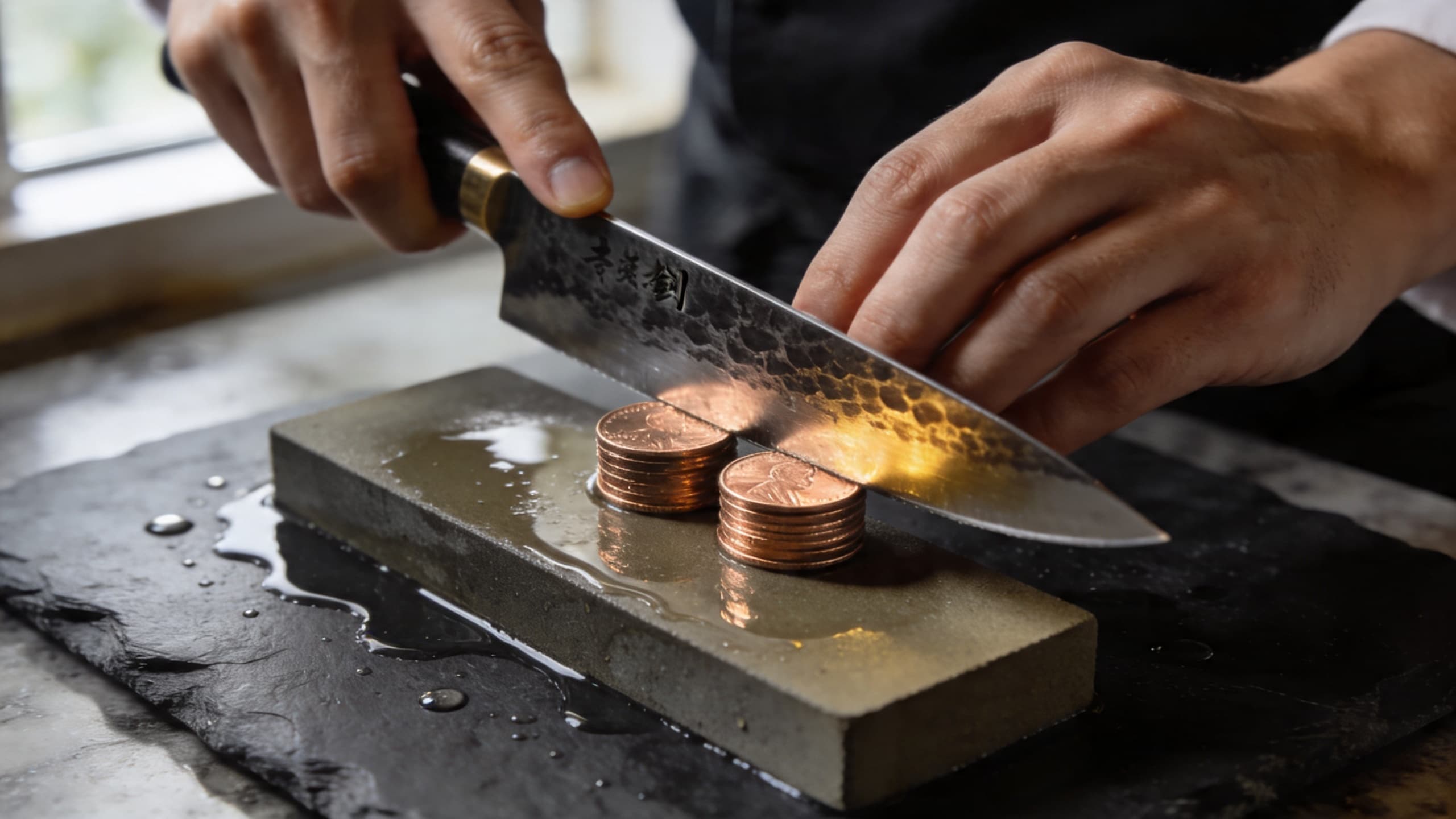
For a French-style chef's knife, you’re looking at about 20 degrees. For my preferred Japanese carbon steel blades, we’re talking a razor-sharp 12 to 15 degrees.
Pro Tip: If you struggle to visualize the angle, use the "Two Penny Trick." Stack two pennies on your stone and rest the spine of your knife on them. That’s roughly 15 degrees. Keep that consistent throughout the entire stroke. Consistency is more important than the exact degree.
3. Ignoring the "Burr"
Sharpening isn't just about removing metal; it’s about moving it. As you sharpen one side, you are essentially pushing a microscopic "wire" of metal over to the other side. This is called a burr. If you don't feel for that burr, you don't know if you've actually reached the edge.
I remember my old Chef de Cuisine in Paris screaming, "Jimbob, if you cannot feel the wire, you are just polishing a spoon!" He was right. You must sharpen one side until you feel that tiny rough edge along the entire length of the blade, then flip and repeat.
Great cooking is about technique, not complexity. A sharp knife is the ultimate expression of that technique.
4. The Honing vs. Sharpening Confusion
This is the most frequent "lifestyle" mistake. People think that using a honing steel (that long metal rod in your knife block) is sharpening. It isn't. Honing simply realigns the microscopic teeth of an already sharp edge.
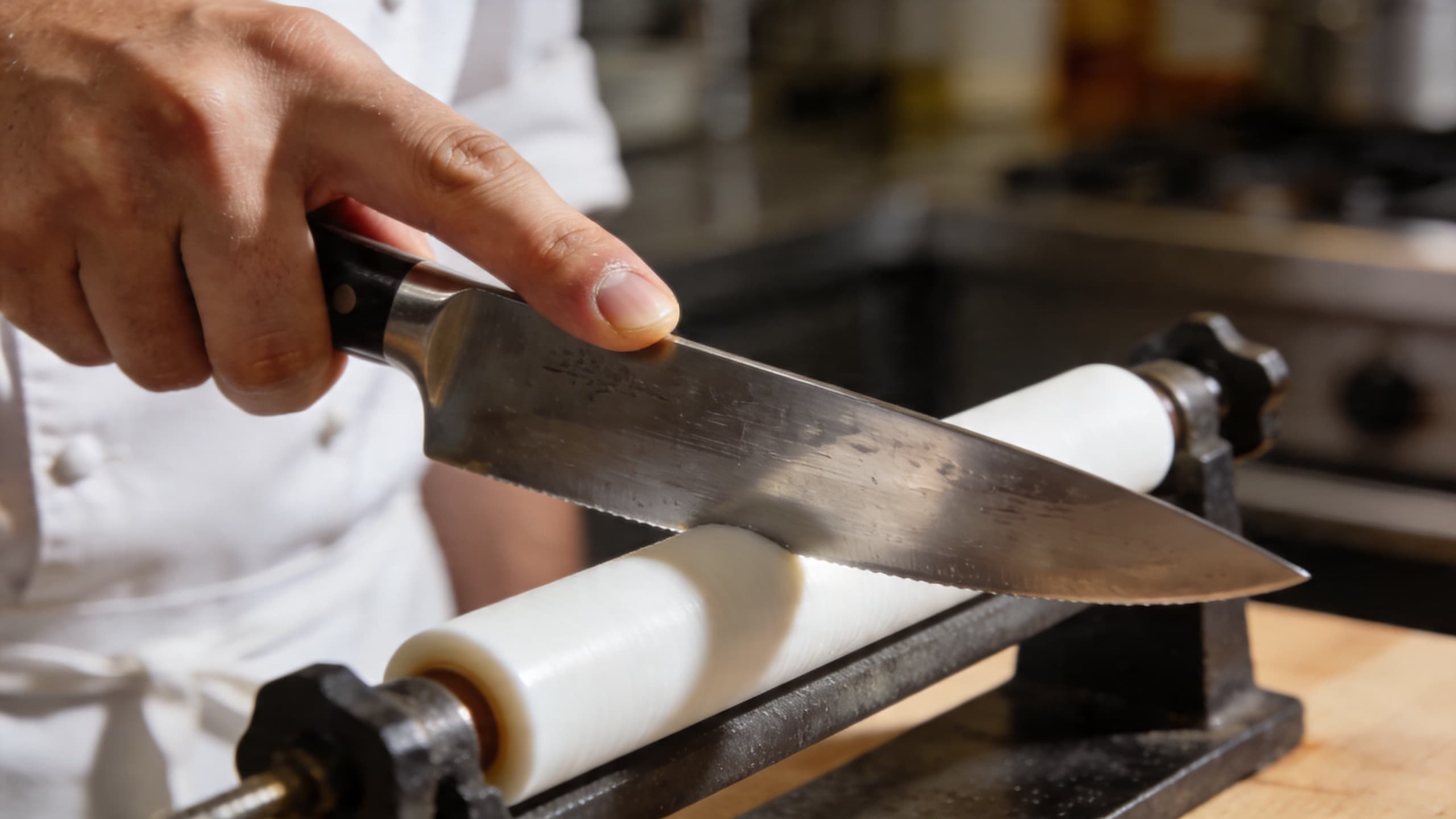
If your knife is actually dull, you can hon it until your arm falls off and it won't get sharper. You need the abrasive grit of a stone to remove metal and create a new edge.
Key Takeaway: Sharpen on stones every 3-6 months depending on use. Hon your blade every single time it touches the cutting board. It’s a 10-second ritual that keeps your precision at a Michelin level.
5. The "One-Stone" Myth
You can't finish a high-end reduction in a dirty pan, and you can't finish a precision edge on a coarse stone. If you only use a 400-grit stone, your knife will have "teeth"—it'll tear through meat, but it won't glide through a delicate basil leaf.
You need a progression. Start with a medium grit (around 1000) to set the edge, and finish on a fine grit (3000 to 6000) to polish it. This is how you get that "scary sharp" feel that makes prep work feel like a meditation rather than a chore.
The Daily Edge Ritual
If you want to maintain that fusion-ready edge, you need a routine. It’s not just about the tools; it’s about the habit.
- The Morning Hon: Before the first onion is cut, give it 5 passes on each side of a ceramic honing rod.
- The Clean Wipe: Never, ever put your knife in the dishwasher. The high-heat and caustic detergent will dull the edge faster than a stone countertop. Hand wash, hand dry.
- The Soft Landing: Only use wood or high-quality synthetic boards. Glass or marble boards are essentially "knife executioners."
Warning: A dull knife is significantly more dangerous than a sharp one. A sharp knife goes exactly where you point it. A dull knife wanders—and usually wanders toward your thumb.
Keeping your knives in peak condition is a form of kitchen mindfulness. It forces you to slow down, respect your tools, and appreciate the physics of the ingredients you’re working with. Whether you're breaking down a brisket for the smoker or julienning peppers for a Calabrian chili relish, do it with an edge that reflects your standards.
Keep it classy, keep it smoky. And for heaven's sake, keep it sharp.
#knifeskills #cheftech #kitchenhacks #precisioncooking