

The Edge of Disaster: 5 Knife Mistakes That Will Break Your Kitchen Flow
Why speed kills and precision heals in the world of high-end French-Italian prep.

The kitchen is a theater of physics and flavor, but it’s also a place where a single millimeter of error can turn a Michelin-star service into a trip to the ER. We’ve all been there—trying to show off a lightning-fast brunoise or wrestling with a stubborn, fibrous artichoke—only to realize the knife has a mind of its own. In my fifteen years behind the line, I’ve learned that precision isn't just about aesthetics; it’s about survival.
If you want to master the delicate intersection of French technique and Italian soul, you have to respect the steel. Whether you're prepping tiny, slippery cipollini onions for a balsamic reduction or trimming artichokes for a wood-fired finish, your grip and your mindset are what stand between a stunning plate and a permanent scar.
1. The "Hero Complex" Slip
Early in my career, I thought speed was the ultimate metric of a chef. I was flying through a bag of shallots, eyes on the clock instead of the blade. The knife caught the curve of the shallot, slid off the skin, and decided my index finger looked like a garnish.
Tip: Speed is a byproduct of accuracy, not the goal. If you can't do the cut perfectly at a snail's pace, you have no business trying to do it fast.
In French-Italian fusion, we deal with a lot of "spherical challenges"—think cipollini onions or small shallots. These alliums are notorious for rolling. To master them, you must create a flat surface immediately. One decisive slice to create a base will save your fingertips every time.
2. The Dull Blade Deception
It sounds counterintuitive, but a dull knife is infinitely more dangerous than a razor-sharp one. When a blade is dull, you apply more downward pressure to force the cut. That extra force is exactly what causes the knife to "jump" when it finally breaks through the resistance.
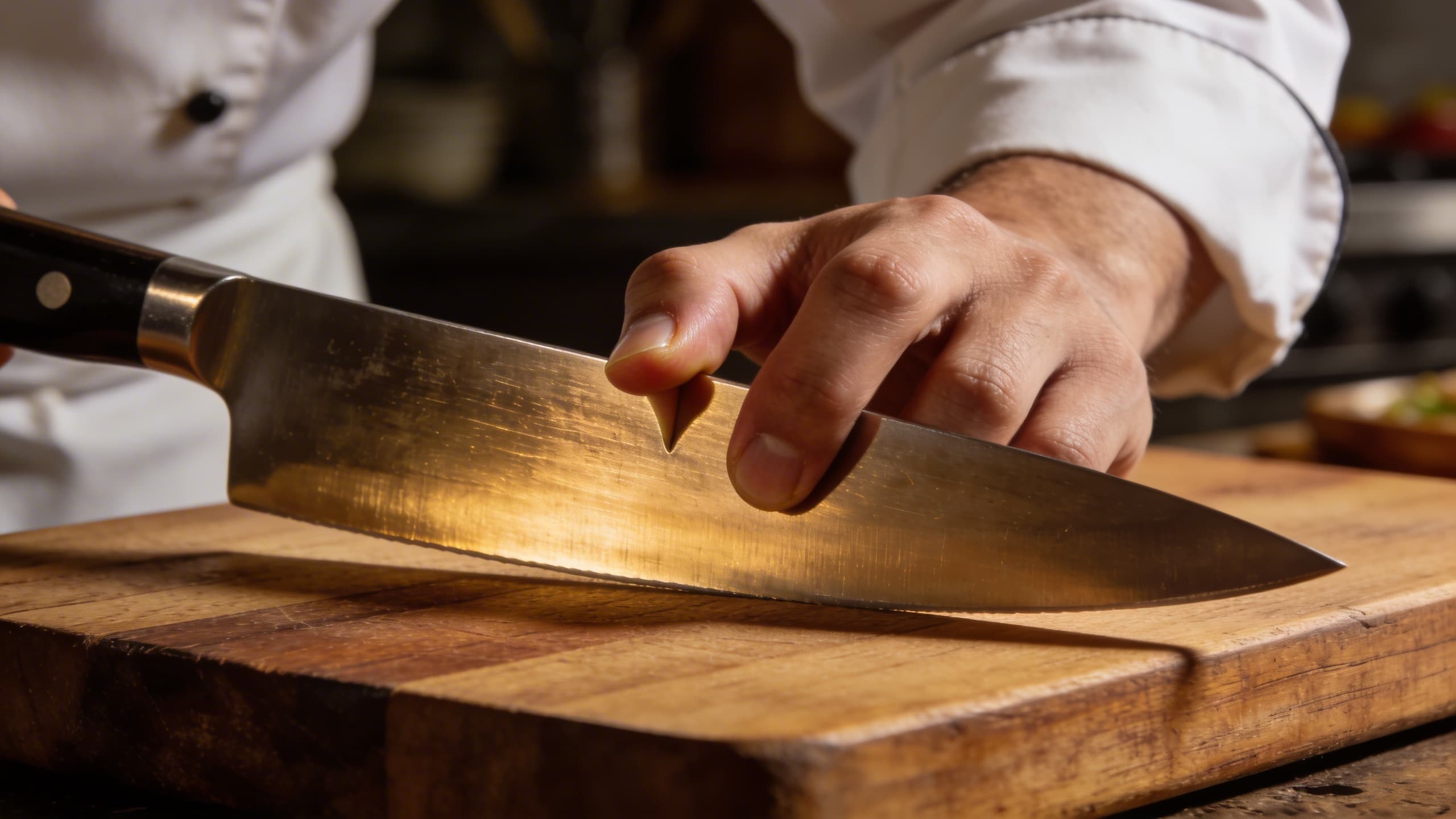
Did You Know? According to kitchen safety data, a significant percentage of lacerations occur because the user was over-compensating for a blunt edge. A sharp knife bites into the vegetable; a dull knife slides across it.
3. The Artichoke Ambush
Artichokes are the final boss of vegetable prep. They are fibrous, armored, and require a specific "turning" technique (the French tourné) to reveal the heart. My mistake? Using a massive chef's knife for a job that required a paring knife’s finesse. I slipped while trying to hack through the stem and nearly lost the webbing of my thumb.
To prep an artichoke with precision:
- Use a serrated knife for the initial "beheading."
- Switch to a sharp paring knife or a bird's beak knife for the "turning."
- Keep the blade facing away from your body as you rotate the artichoke against the edge.
Pro Tip: Keep a bowl of acidulated water (lemon and water) nearby. Artichokes oxidize faster than a cheap smoker in the rain. As soon as you make a cut, submerge it.
4. The "Floating" Cutting Board
If your board moves, your fingers are at risk. I once witnessed a junior chef try to dice a cold, hard butternut squash on a dry board. The board slid, the knife followed, and the service was down a man before the first appetizer hit the table.
Key Takeaway: Always place a damp paper towel or a silicone mat under your cutting board. It should be an extension of the table—immovable and steady.
5. The Fingertip Exposure
The "Claw" isn't just a suggestion; it’s the foundation of professional knife work. In the heat of a busy Italian kitchen, it’s easy to let your middle finger drift forward. That’s how you end up with "the chef’s manicure"—a sliced-off nail.
Mastering the Fusion Prep: Artichokes & Cipollini
When we blend French precision with Italian ingredients, the prep is where the magic happens. For cipollini onions, don't just hack them. Blanch them in boiling water for 30 seconds first; the skins will slip right off, leaving that beautiful, flat disc shape intact for a perfect sear.
For artichokes, the goal is a smooth, sculpted surface. Every cut should be deliberate. You aren't just removing leaves; you're revealing the architecture of the vegetable.
Great cooking is about technique, not complexity. If you can't respect the tool, you can't respect the ingredient.
Warning: Never try to catch a falling knife. A dropped knife has no handle. Let it hit the floor, step back, and wash it later. Your toes will thank you.
Keep your knives sharp, your knuckles tucked, and your ego in check. The pit doesn't lie, and neither does a sharp blade. Keep it classy, keep it smoky, and for heaven's sake, keep your fingers.
#knifeskills #chefslife #culinarytechnique #kitchensafety #freshprep