

5 Rookie Mistakes in Cold-Smoking Delicate Ingredients (And How Precision Saves the Day)
Mastering the delicate art of smoke without the fire or the waste.

If you’ve ever tried to cold-smoke a delicate piece of sea bass or a block of artisanal Fontina and ended up with a literal grease fire or a science experiment gone wrong, you aren't alone. We’ve all been there—usually standing over a smoldering pile of wasted ingredients, wondering where the "precision" went. Cold-smoking is the ultimate flex in the fusion kitchen, but without the right thermodynamics and a healthy respect for the danger zone, it’s just an expensive way to ruin lunch.
I’ve spent years balancing the smoky traditions of the backyard with the rigorous technique of a Michelin-starred larder. I’ve got the singed eyebrows to prove that when it comes to delicate infusions, the difference between a "stunning aromatic profile" and "inedible soot" is about five degrees and a lot of patience.
Here is how to stop burning through your grocery budget and start mastering the cold-smoke.
1. The "Heat Creep" Catastrophe
The biggest rookie mistake? Thinking a "low" fire is a "cold" smoke. Cold-smoking must happen below 86°F (30°C). Anything higher and you aren't infusing; you're melting. I once tried to cold-smoke a batch of hand-rolled butter for a French-Italian compound experiment. I thought my offset was "cool enough." Five minutes later, I had a puddle of liquid gold dripping into the ash pan.
Tip: Use a secondary smoking chamber or a "smoke tube" filled with pellets. This keeps the heat source physically separated from your ingredients, allowing the smoke to cool as it travels.
The Precision Fix:
Invest in a high-quality digital thermometer with an ambient probe. If that temperature ticks toward 90°F, pull the food. To save money, you can even use a cardboard box as your smoking chamber—it’s a great insulator that doesn't hold onto heat like heavy steel does.
2. Ignoring the "Danger Zone" (Safety First, Chef)
Cold-smoking is not cooking. It is a flavor application. Because the food stays between 40°F and 140°F, you are in the literal breeding ground for bacteria like Listeria and Clostridium botulinum.
Great flavor is never worth a trip to the ER. If you aren't curing, you aren't preserving.
The Precision Fix:
If you are smoking fish or meat, a proper salt-and-sugar cure is non-negotiable. For delicate fusion ingredients like cheeses or vegetables, keep the smoke sessions short (20-60 minutes) and get the food back into the fridge immediately.
3. The "Dirty Smoke" Disaster
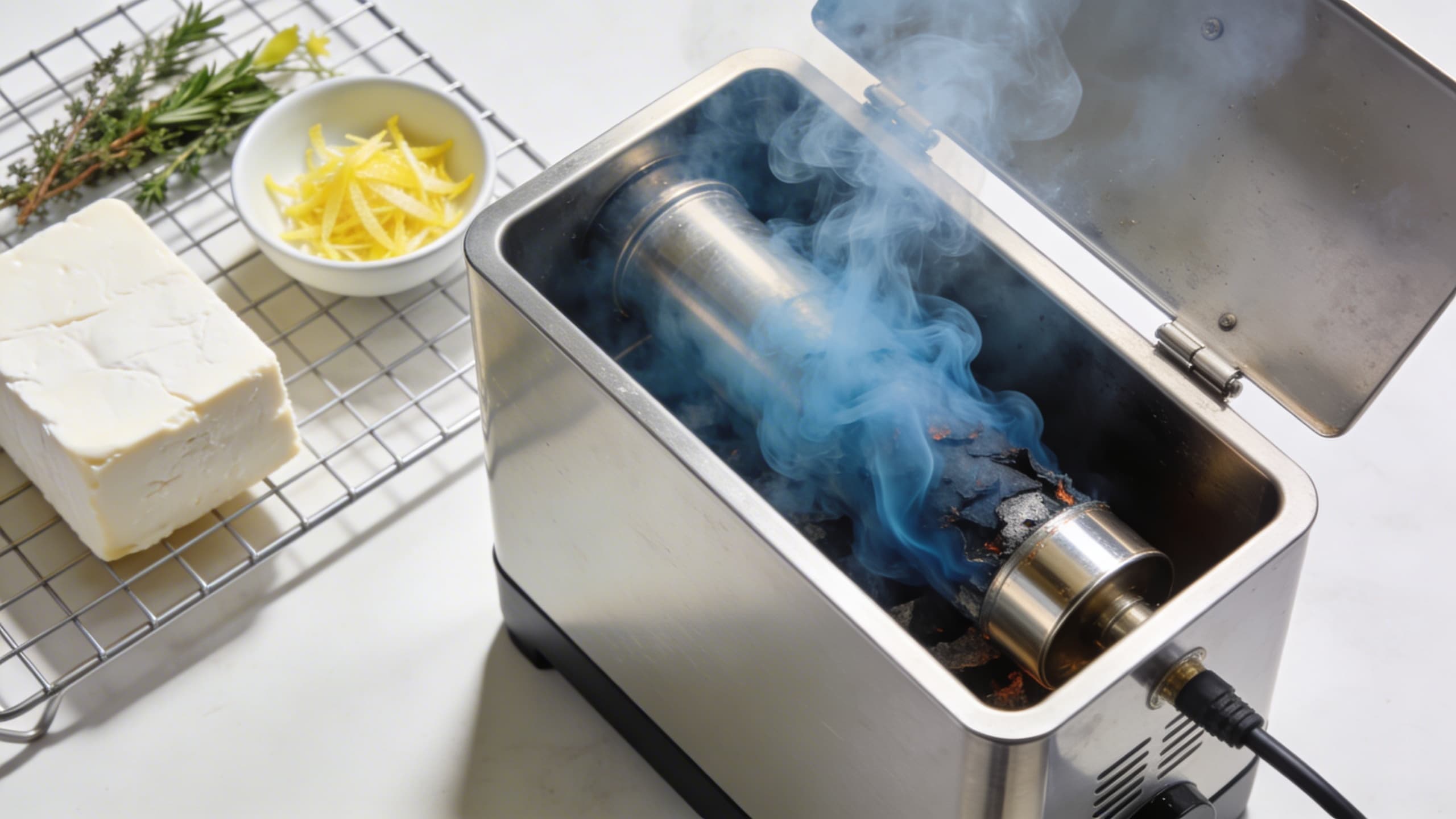
We want blue smoke, not white billows. Thick, white smoke contains creosote—a bitter, oily byproduct that tastes like a campfire’s gym socks. On a delicate scallop or a light ricotta, creosote is a death sentence for flavor.
Pro Tip: Let your smoke source run for 10 minutes before adding the food. You want to see a faint, translucent blue shimmer, not a heavy fog.
The Precision Fix:
This is where my French-Italian flair comes in. Instead of heavy hickory, use Cherry wood. It’s subtle, sweet, and pairs beautifully with Mediterranean aromatics. I like to toss dried gremolata herbs (lemon peel, parsley, garlic) directly onto the embers or into the pellet tube for a bright, herbaceous lift that cuts through the smoke.
4. Skipping the "Pellicle" Phase
If your food comes out of the smoker looking splotchy or tasting uneven, you skipped the drying phase. Smoke sticks to moisture, but it bonds to a pellicle—a tacky, thin skin that forms on the surface of the food.
The Precision Fix:
After curing or prepping your ingredients, let them sit uncovered in the fridge on a wire rack for 2-4 hours. This creates the perfect surface "viscosity" for the smoke to adhere to. It’s a zero-cost step that doubles the quality of your final product.
5. Over-Smoking (The "Ashtray" Effect)
More smoke does not equal better flavor. Delicate ingredients have a low saturation point. If you leave a delicate goat cheese in for three hours, it will taste like an ashtray.
Key Takeaway: Start small. You can always add more smoke later, but you can't take it out once it's in the fibers.
The Bottom Line: Precision Saves Your Wallet
Mastering these techniques isn't just about being a "pro"—it's about respecting the ingredients. When you stop wasting expensive proteins and cheeses on failed experiments, your kitchen becomes more sustainable and your flavors become more nuanced.
Keep it classy, keep it smoky.
#coldsmoking #foodscience #bbqtechnique #frenchitalianfusion #kitchensafety